Menu
Cover Page
Colophon
TOCs
Table of Content
List of Images
List of Tables
Front
Introduction
Before you start
Chapters
PART I
Parliamentary data in Social Sciences and Humanities research
Further reading
Working with Parliamentary Corpora: Transcripts, Proceedings, and Comparative Insights
Source data
Further reading
Parliamentary proceedings as evidence of parliamentary activity
Further reading
The comparative perspective
Further reading
The ParlaMint project
ParlaMint I and ParlaMint II: a retrospect
Related projects: ParlaCAP and ParlaSpeech
The ParlaMint corpora
Data access
Corpus file download option
Online tools with preloaded data – noSketch Engine and TEITOK
TEITOK versus noSketch Engine
Main TEITOK features
From noSketch Engine to TEITOK
Corpus provenance, structure and annotations
Provenance information
Structural markup
Structural elements and tokenisation
Linguistic annotation
Linguistic elements and lemmatisation
Lowercase version
Grammatical annotations
Metadata
Overview of metadata in noSketch Engine
Sociodemographic and temporal information
Political organisation metadata
Integrated subcorpora
Topic information
Sentiment information
Transcriber notes
Named entities
Semantic annotation
Some considerations
PART II
Getting ready
Showcase I: the gendered dimension of topic distribution
Research aim & questions
Research data
Research techniques
Research procedure
Step I: metadata-based subcorpus creation
Step II: frequency list creation
Step III: frequency list interpretation
Step IV: concordance-based subcorpus creation
Step V: keywords list creation
Keywords lists for subcorpora on macroeconomics
Keywords lists for subcorpora on health
Step VI: keywords list analysis and interpretation
Analysing the keywords on macroeconomics
Interpreting the keywords on macroeconomics
Analysing the keywords on health
Interpreting the keywords on health
Showcase II: sentiment analysis in parliamentary discourse
Research aim & questions
Research data
Research techniques
Research procedure
Step I: composing simple and CQL search queries
Step II: retrieving sentiment frequency and density
Interpreting the results
Step III: calculating ratio of relative frequencies as an indicator of political polarisation in the UK parliament
Interpreting the results
Step IV: reading raw sentiment scores and concordance lines
Interpreting the results
Step V: extracting collocates
Interpreting the results
Step VI: comparing keywords to capture sentiment differences
Interpreting the results
Bibliography
Appendices
Glossary
Acknowledgement
Cover Page
Colophon
TOCs
Table of Content
List of Images
List of Tables
Front
Introduction
Before you start
Chapters
PART I
Parliamentary data in Social Sciences and Humanities research
Further reading
Working with Parliamentary Corpora: Transcripts, Proceedings, and Comparative Insights
Source data
Further reading
Parliamentary proceedings as evidence of parliamentary activity
Further reading
The comparative perspective
Further reading
The ParlaMint project
ParlaMint I and ParlaMint II: a retrospect
Related projects: ParlaCAP and ParlaSpeech
The ParlaMint corpora
Data access
Corpus file download option
Online tools with preloaded data – noSketch Engine and TEITOK
TEITOK versus noSketch Engine
Main TEITOK features
From noSketch Engine to TEITOK
Corpus provenance, structure and annotations
Provenance information
Structural markup
Structural elements and tokenisation
Linguistic annotation
Linguistic elements and lemmatisation
Lowercase version
Grammatical annotations
Metadata
Overview of metadata in noSketch Engine
Sociodemographic and temporal information
Political organisation metadata
Integrated subcorpora
Topic information
Sentiment information
Transcriber notes
Named entities
Semantic annotation
Some considerations
PART II
Getting ready
Showcase I: the gendered dimension of topic distribution
Research aim & questions
Research data
Research techniques
Research procedure
Step I: metadata-based subcorpus creation
Step II: frequency list creation
Step III: frequency list interpretation
Step IV: concordance-based subcorpus creation
Step V: keywords list creation
Keywords lists for subcorpora on macroeconomics
Keywords lists for subcorpora on health
Step VI: keywords list analysis and interpretation
Analysing the keywords on macroeconomics
Interpreting the keywords on macroeconomics
Analysing the keywords on health
Interpreting the keywords on health
Showcase II: sentiment analysis in parliamentary discourse
Research aim & questions
Research data
Research techniques
Research procedure
Step I: composing simple and CQL search queries
Step II: retrieving sentiment frequency and density
Interpreting the results
Step III: calculating ratio of relative frequencies as an indicator of political polarisation in the UK parliament
Interpreting the results
Step IV: reading raw sentiment scores and concordance lines
Interpreting the results
Step V: extracting collocates
Interpreting the results
Step VI: comparing keywords to capture sentiment differences
Interpreting the results
Bibliography
Appendices
Glossary
Acknowledgement
Kristina Pahor de Maiti Tekavčič
Anna Kryvenko
From the Dispatch Box:
Unlocking the Potential of ParlaMint Through noSketch Engine and TEITOK
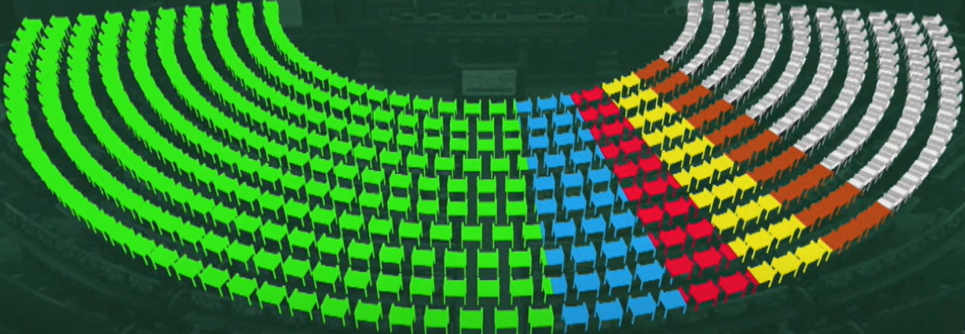
Image source:
espreso.tv
